Russian influence in the South Caucasus continues to erode, as Armenian Prime Minister Nikol Pashinyan has indicated that Moscow can no longer be considered Yerevan’s strategic partner. Elsewhere, Azerbaijan’s relationship with Russia is back on the rocks.
Pashinyan, speaking at an August 27 news conference , reiterated a long-standing position that Russia failed to fulfill its treaty obligations to come to Armenia’s assistance during the Second Karabakh War, adding that, given the Kremlin’s inaction in 2022, “how can we say that there is a strategic partnership?”
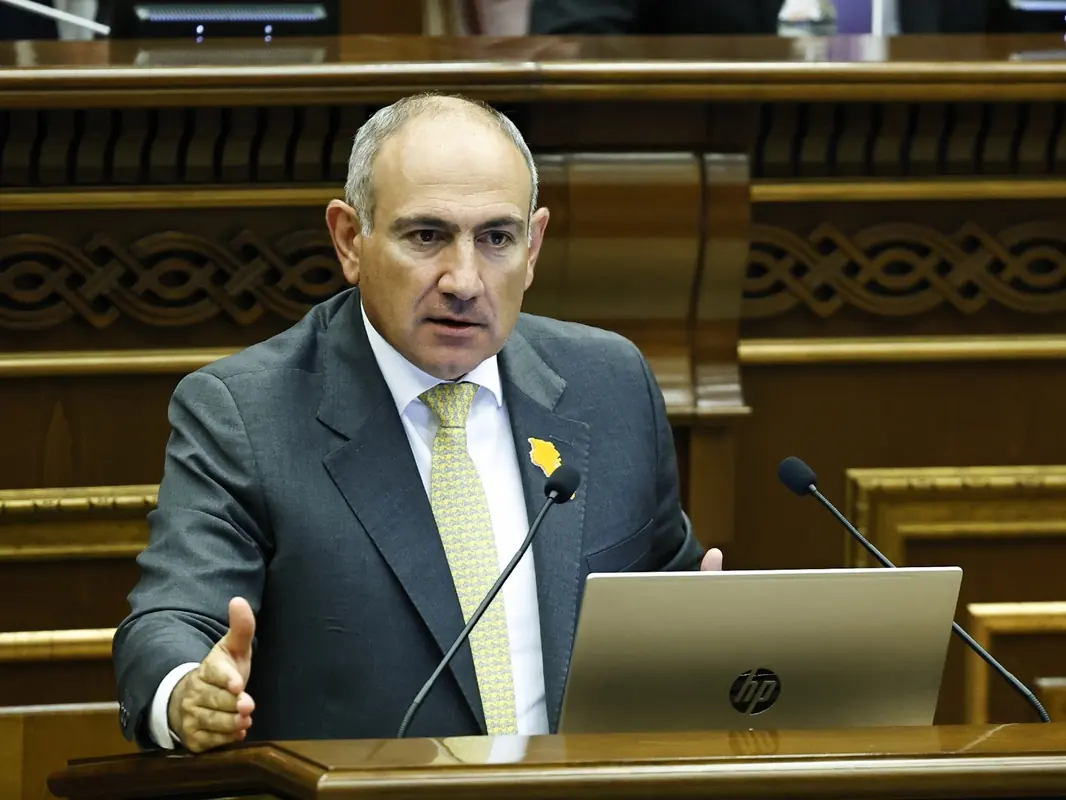
In an earlier speech in parliament, Pashinyan laid out his government’s vision for gaining membership in the European Union. At some point “in the near future,” he stated, the government will apply for EU membership. If Brussels offers positive feedback, Armenia will then launch discussions on an accession roadmap, and once such a plan is in place, the government will put the issue of accession to a national referendum.
Pashinyan’s plan drew immediate howls from Moscow. Foreign Ministry spokeswoman Maria Zakharova accused Armenia of trying to have it all ways, noting that Yerevan is already a member of the Russia-led Eurasian Economic Union (EAEU). Moscow’s position is that Yerevan cannot be a member of both groups and will have to choose.
Pashinyan’s plan “reveals fundamental contradictions,” Zakharova said at a Moscow briefing August 27. “This tactic by the Armenian authorities appears frankly inappropriate: [Armenia] intends to gain the benefits of EU membership without sacrificing its privileges within the EAEU.”
Lacking any guarantees of EU membership, Zakharova added, Yerevan “risks not only failing to join the EU, but also irrevocably undermining relations with Russia and other [EAEU] member states.”
Russian Foreign Minister Sergei Lavrov claimed that Pashinyan’s plan revealed his government’s “ lack of trust ” in Armenia’s electorate. It is worth noting that watchdog groups found that Russia devoted lots of time and resources to an unsuccessful attempt to manipulate Armenia’s June parliamentary elections and prevent the Pashinyan government’s reelection.
Some regional analysts contend the risks related to the potential loss of EAEU perks and a break with Moscow may not be so great for Yerevan. While Russia remains Armenia’s dominant trade partner, bilateral turnover has plunged in recent years. During the January-May period of 2026, turnover fell about 21 percent to $2.2 billion, compared with the same period the previous year. Armenia’s share of overall trade with EAEU member states declined from 37 percent to 30 percent within the same timeframe.
Russia has also called the viability of the EAEU as a free trade entity into question by imposing bans on some Armenian goods, violating at least the spirit of the group’s founding treaty .
Meanwhile, the Kremlin’s relationship with Azerbaijan is experiencing more turbulent times. Bilateral relations have been unstable since Russian air defense forces accidentally shot down a civilian Azerbaijani jetliner in December 2024. The two countries appeared to mend the rift earlier in 2026, but recent harsh rhetorical exchanges indicate that underlying tension has not dissipated.
On August 27, Azerbaijan complained about a “provocation” outside a building belonging to Azerbaijan’s Embassy in Moscow. An Azerbaijani government statement called on Russian officials to take immediate action to put an end to what it considers deliberately antagonistic actions sponsored by Russian authorities.
“This unacceptable provocation, in addition to serving to artificially strain Azerbaijani-Russian relations, is not excluded as part of the dirty and biased campaign against Azerbaijan conducted in a number of [state-aligned] Russian media resources in recent times,” the statement read.